
“I form the light, and create darkness: I make peace, and create evil: I the Lord do all these things.” (Old Testament – Isaiah 45:7)
“Indeed, We have placed over their hearts coverings, lest they understand it, and in their ears deafness. And if you invite them to guidance – they will never be guided, then – ever.” (Quran – Surah Al-Kahf – Verse 57, Saheeh International translation)
In an era when the COVID-19 virus is rampaging across the world, conquering and expanding its domain, and toying with human lives in the grip of its retribution and mercy, raising the ancient and historical question of evil is hardly ill-timed. We know that the outbreak of this virus in Iran began in the city of Qom (and likely from the religious seminary), one of the holiest sites in Shiism, and spread to all of Iran. Much has been said about how this virus, all on its own, mocked the formidable standing of this holy city and sparked a fresh wave of criticisms, challenges, critiques, as well as spirited defenses from the traditional clergy and religious intellectuals. In this short discourse, however, I deem it fitting to write a little about the problem of evil and the objections leveled against the claims of Abrahamic religions, as well as briefly expound upon four common and well-known arguments (the four theodicies) justifying the problem of evil in religious belief, and present short critiques of them. Meanwhile, I will briefly touch upon the responses of Dr. Yasser Mirdamadi, belonging to the school of religious reformists, in his interview with Taha Parsa published on the Zeitoon website (https://www.zeitoons.com/75479).
The problem of evil has anciently been, and continues to be, one of the most controversial and inconclusive debates in the history of the philosophy of religion. Very briefly, the issue can be framed as follows: Is it possible to attribute the attributes of omnipotence, omniscience, and benevolence / all-mercifulness (al-Rahman and al-Rahim) to the creator of a world in which evil and wickedness exist? And can all three of these attributes coalesce in one place? (In this discussion, Rahman and Rahim are taken as one; to avoid theological disputes, we merely note that according to some scholars, Rahman denotes universal mercy, while Rahim signifies kindness and mercy reserved solely for believers.)
First, the Definition of the Word “Evil”
In short, we use the term evil or wickedness to mean the painful, tormenting, fatal, distressing, agonizing, and generally negative experiences that sentient and perceptive beings undergo in this world. (Possessing intellect is not a prerequisite for experiencing evil; thus, it can be argued that the experience of evil in this world is not confined to humans, who are likely the only sapient beings inhabiting this planet.) These negative experiences are categorized into physical and material experiences such as hunger, cold, pain, sickness, mental and bodily disability… and mental-spiritual experiences such as misery, destitution, suffering, sorrow, affliction, anxiety, distress, fear, psychiatric and psychological disorders… Physical experiences may be termed pain, and spiritual/mental experiences termed suffering. Taking into account that pain and suffering are inseparable parts of life on Earth, one can assert that evil and wickedness exist on a daily basis in the lives of humans and animals.
Philosophers of religion have also offered more challenging and intricate definitions. For example, Saint Augustine defined evil as that which we fear, and in one sense even called it fear itself. In a section of the novel In Cold Blood, its author Truman Capote depicts a small town in America that, following a series of murders, has turned into a madhouse of fear and anxiety, with people swarming shops to buy locks and iron grates for their homes. Capote remarks somewhere:
“Locks do not matter much, for imagination can open any iron door, easily turning the key to enter your home.”
Accordingly, the act of murder and the fear and terror resulting from it can be designated as two distinct kinds of evil: one causing physical pain and torment, and the other causing spiritual-mental suffering.
Of course, both Saint Augustine and Saint Thomas Aquinas are very delicately careful in their writings that their conception of evil should not be interpreted as an independent entity or phenomenon in the world, such as the Manichaean definitions of Ahriman (in the aforementioned religion and similar creeds, Ahriman, as the founder and representative of evil, possesses an independent, active, and willing presence in the world). They define evil, in short, as the privation or absence of God at a particular time or place. Their system of argumentation aligns to a great extent with the philosophical systems of Plato and Aristotle, which link goodness to purpose. For example, in the Aristotelian system, goodness means the actualization of all the potential attributes of a thing. Therefore, for instance, a good sword is one that possesses the virtues of lightness, balance, beauty, and efficiency, and readily enables severing an adversary’s head. And a good grapevine is one that carries out photosynthesis well, uses less water, fights pests more vigorously, and produces large, delicious grapes. The curious point here is that according to the above reasoning, a good virus would likely be a virus that infects the greatest number of victims in the shortest possible time, with no vaccine or preventive tool available! That is, if we consider the coronavirus, for example, to be the product of God’s craftsmanship, in truth we must hold God responsible for the evil generated. For the said virus merely acted upon its potential attributes and demonstrated that it is a creature that fulfills the purpose of its creation remarkably well. At any rate, for Augustine, evil has no independent ontological reality; in the absence of the divine ray of light, the absence of goodness takes shape, disrupting the process of growth, thriving, soaring, and the realization of human fundamental and potential ends.
Elsewhere, Saint Augustine likens evil to the corruption and destruction of the natural order in the nature or arrangement of things, seeing the essence of evil in the disruption of the natural order. He claims that God’s absence disrupts the order of nature and initiates evil. Now, one might raise the question: How can a God—one of whose negative attributes is eternal presence in all times and all places—be absent at a specific time or place and thereby cause evil? In the Augustinian system, God created out of mercy, and evil is the result of disorder in the merciful creation of the Almighty. Again, the question arises: Why did an omniscient, omnipotent, and all-merciful God create in such a way that the occasion and ground for disrupting the order of His creation would exist?
Natural Evil and Moral Evil
Here, it is appropriate to briefly define two conventional terms in the philosophy of religion: natural evil, which refers conventionally to pain and suffering stemming from natural (non-human) causes, and moral evil, which specifically pertains to pain and suffering brought about by human agency and choices in this world. If we assume humans possess free will and volition, moral evil and natural evil will be distinct from one another.
A famous example of natural evil is the 1755 Lisbon earthquake, which reduced the city to rubble. Shortly thereafter, an immense tsunami crashed upon the city; whatever and whoever had escaped the earthquake were caught in a catastrophic deluge. And after the destructive flood, as if nature’s wrath had not yet subsided, a raging fire engulfed the city’s ruins in its ruthless flames, burning for days. The toll of the victims of the earthquake, tsunami, and fire has been reported to be as high as one hundred thousand.
Voltaire, the French philosopher, composed the following lines concerning this disaster:
“O philosophers who mistakenly cry that ‘all is well,’
Hasten hither, and contemplate these dreadful ruins.
Behold these shattered bodies beneath the debris of these marble pillars.
This cruel earth has swallowed a hundred thousand unfortunates into the maw of its wickedness…”
Countless other examples of natural evil are recorded in history: the 2004 tsunami in Japan, the Bam earthquake, the outbreak of the Plague in the Middle Ages, cancer and the evasion of cancer cells from the body’s immune system, the savagery, pain, and horror latent in the natural world, such as the ichneumon wasp (ichneumonidae) which lays its eggs inside the body of its host, its larvae feeding on the poor caterpillars and eating their prey alive from within; the botfly which lays its eggs in the eye of a human child, its maggots emerging from the living child’s eye and leaving them blind and disfigured; the mass extinction of millions upon millions of dinosaurs roughly sixty-five million years ago; the human and non-human victims of viruses, bacteria, genetic mutations that render human and animal children deformed and intellectually disabled, and so forth. The number of examples is virtually limitless, readily justifying Darwin’s remark that nature’s claws are red to the elbows, stained with the blood of its victims.
Of course, the response of atheists and secularists to natural evil is very simple: they explain the relationships between living organisms through evolution and natural selection, viewing evil as a human interpretation of change in nature and the expansion of life. Fundamentally, in a system that does not regard human beings as the center and purpose of the universe and the final cause of creation, but rather views life as an interconnected continuum that expands by diversifying and recycling itself without any ultimate teleological purpose assigned to it, a problem known as evil simply does not arise.
Regarding moral evil, however, it must be said that we designate as moral evil those unjust, oppressive, cruel, malicious, abusive, and exploitative acts inflicted by one human upon another human or upon animals. Events such as massive genocides throughout history: the massacre of the Jews of Medina, the slaughter of Musaylima and his supporters at the hands of Abu Bakr, the slaughter of Jews during World War II, the slaughter of Iranians by the Mongols, the widespread slaughter of Iranians by Muslim conquerors during the first three centuries, the slaughter and genocide by Sultan Mahmud in India, the Armenian Genocide in the early twentieth century at the hands of the Ottomans, the mass executions in the Soviet Union, Cambodia, China, Romania, the 1994 genocide in Rwanda, and so on. Of course, personal examples of pain and suffering that humans have caused and continue to cause for themselves and others within family, tribe, city, neighborhood, and surrounding environment exceed all limits and cannot be cataloged. Humans routinely abuse, torture, rape, exploit, violate the rights of, and in various ways insult and humiliate one another… and typically, a high percentage of these acts are overlooked, forgotten, and go without punishment or justice.
According to some philosophers, natural evil is the outcome of moral evil—meaning that through their wicked deeds, humans cause droughts, famines, starvations, and the like. Some even believe that the emergence of HIV or COVID-19 can be attributed to human evil deeds. Of course, in the modern world, there are many indications of the impact of human choices and actions in generating environmental crises, and there is no doubt that since the advent of modern humans, tool-making, and the discovery of fire, vast forests and plains have burned or been emptied of life, countless animal and plant species have gone extinct, lakes and rivers have dried up, oceans and seas have been polluted with toxic chemicals, and most important of all is global warming, which is perhaps the most significant natural evil humans have created through their choices to date. Saint Augustine asserts that humans defiled the perfect, pure, and wholesome world God had delivered to them through original sin (eating from the forbidden tree), breathing evil into this world; and that all natural evil is, in a sense, divine retribution for eating the forbidden fruit is Augustine’s logical conclusion from the creation narrative. While it can be conceded without doubt that humans over their several-hundred-thousand-year history have added to the world’s evil, can all natural evil be attributed to humanity? Scientifically, life originated roughly 3.5 billion years before the appearance of modern humans on this planet, and the volume of natural evil that existed and exists independently of humans over this vast expanse of time, compared to the volume of evil caused by humans, is practically like comparing one to infinity. Therefore, one can conclude that attributing all the natural evil of history to humans has virtually no scientific basis and, in the modern world, is an anti-rational proposition.
In the opening part of his conversation discussing the problem of evil, Mr. Mirdamadi points out that humans could also be the agents of natural evil, stating:
“Suppose the origin of the corona crisis was just as reported in the media: the coronavirus was transmitted from a bat to a rare species of pangolin, and someone/some people exercised their free will to eat pangolin meat, thereby contracting the coronavirus, which spread and caused the present worldwide health crisis. On this account, the origin of this crisis is human voluntary action, and hence it is not an entirely natural crisis like a flood or an earthquake. Therefore, based on the model of open theism, insofar as the emergence of this crisis traces back to human voluntary and deliberate action, God did not have foreknowledge of this crisis, because in order to enable human free will and agency in their contingent acts, God chose not to know it in advance. In this manner, the problem of moral evil is resolved; that is, the responsibility for evils in whose production human will and free agency are involved will not rest with God.”
Critique of Open Theism
In response to the above argument, we must first briefly define open theism.
Before that, however, it is worth noting that even if we attribute the COVID-19 or HIV crisis to humans, does this justify the remainder of the immense natural evil present in the world? Does this argument even justify the creation of an organism like the coronavirus, whose primary potentiality is killing and destroying humans and producing evil? Why were the rest of the viruses and bacteria created—those that were not the result of human misconduct or misbehavior, yet have killed and maimed billions of humans and animals? Can attributing the evil of COVID-19 to human choice negate the immense volume of natural evil in the world?
Regarding open theism, it should be noted that in that part of the doctrine stemming from Christian Protestant theology and relevant to our discussion, God’s knowledge of the future is taken to conflict with human free will. That is, in a hypothetical world where God is aware of human future choices and knows the future, human free will would automatically be violated. According to Mr. Mirdamadi’s statement, if we attribute the COVID-19 crisis to human choice, the burden is lifted from God’s shoulders, and everything is relegated to the wicked choice of one or more individuals (moral evil) who ate pangolin meat. This response in no way accounts for the existence of the colossal volume of natural evil, nor does it explain God’s silence and inaction (given that He possesses both the power and knowledge) in the world, or His failure to restrain evil from afflicting the innocents who became victims of the ignorance of those who consumed pangolin meat.
Returning to the theological discussion, it was argued that God, despite having the capacity to know the future, refrains from viewing it. It must be said that apart from this argument being highly controversial and in conflict with a major body of Christian and Islamic teachings, serious scientific and logical objections also apply to it. Here, I will briefly present two major objections to this argument:
A— In modern physics, following Einstein’s theory of relativity, time is considered the fourth dimension; the three-dimensional universe transforms into a four-dimensional one, where every point in the cosmos possesses spacetime coordinates rather than mere three-dimensional spatial coordinates. According to this theory, past, present, and future all exist simultaneously, and we are merely traveling along these spacetime coordinates. Due to the way our brain functions and because of the faculty of memory, we perceive the world in the present, retain the past as an image in memory, and have not yet experienced the future. But for a being called God, who is outside time and space, the notion that His experience of time mirrors our thoroughly imprecise experience is an erroneous and invalid conception. For an entity situated outside our four-dimensional universe, time, much like a spatial dimension, can be traversed, traveled through, and observed. The entire universe is defined for God as a four-dimensional spacetime continuum (a block of spacetime), and confining such a being to traveling alongside us through a fleeting and limited span of time, rendering Himself unaware of the entire block of spacetime He Himself created, is an utterly flawed idea. The future is a segment of time we have not yet experienced, but for God, not knowing the future is tantamount to being ignorant of His own creation. Our universe, to a transcendent entity (God and other immaterial, divine beings, or any entity looking at the cosmos from outside), is like a three-dimensional film whose beginning, middle, and end can be observed simultaneously in a single glance. In modern physics, this model is referred to as the block universe.
B— Even if we accept the argument of open theism—which arises entirely from a lack of proper understanding of modern physics—we are still confronted with an even more serious dilemma. Even if God does not wish to look at our universe (for a single glance would suffice for Him to see from the moment of the Big Bang to the moment when the outer reaches of the universe recede from each other at the speed of light and spacetime ceases to be), this still means that the future has already occurred, and God merely shuts His eyes, refusing to look, simply because He does not want us to perceive ourselves as bound by determinism. In truth, we are saying that the future is predestined (which, from a relativistic perspective, it is), but so as not to give us an excuse to attribute our actions to the determinism of the cosmic system He created, God claims He does not look into the future so that we may decide freely! In other words, by resorting to willful ignorance, God brings about the affliction and torment of the very beings He created, whereas He could have looked at the future of this world, seen the massive volume of evil, and created it differently, or not created it at all. I believe the fallacy embedded in this argument is thoroughly evident and requires no further elaboration. Needless to say, this in itself stands in stark tension with divine omniscience, and ignorance of the future poses a serious defect for an omniscient entity. Finally, it is worth noting that a large segment of contemporary scientists and modern philosophers consider free will to be a human illusion. Many other modern philosophers approach determinism and free will from the standpoint of compatibilism, deeming it essential for human life to be meaningful that we live in a manner that creates the illusion of free will. On this subject, Strawson the elder, the English philosopher, published an important paper worth examining:
(Freedom and Resentment by P. F. Strawson).
Returning to the problem of evil, we should state that, in the same manner as before, moral evil can also be regarded in a way as the product of natural evil, considering humans as part of nature and captive to nature’s ruthless laws. In that case, in a world where humans did not and do not possess absolute free will, justifying moral evil as part of natural evil is rational. John Stuart Mill, the nineteenth-century philosopher, states in Three Essays on Religion: “that natural evil is the result of the universe not functioning properly—a universe whose original design and purpose was the preservation and maintenance of life, not its destruction.”
Yet the problem of evil has posed a profound dilemma for religion and religious belief for which no adequate solution has yet been provided. We state this problem in the words of the Greek philosopher Epicurus as follows:
“We can posit four logical states, and no more:
A- God wishes to eradicate evil from the world, but cannot.
B- God can eradicate evil from the world, but does not wish to.
C- God neither wishes nor can destroy evil.
D- God both wishes and can eradicate evil from the world.
If (A) is true, God is impotent (which contradicts His omnipotence).
If (B) is true, God is envious or malevolent (which contradicts God’s beautiful attributes and His mercy).
If (C) is true, He is not God at all.
If (D) is true, one must ask: if God is both able and willing, whence comes all this natural and moral evil? And why has God permitted this evil to persist until now?”
A Look at the Arguments of Atheists
These arguments can be divided into two categories:
Logical-a priori
and Evidential-a posteriori.
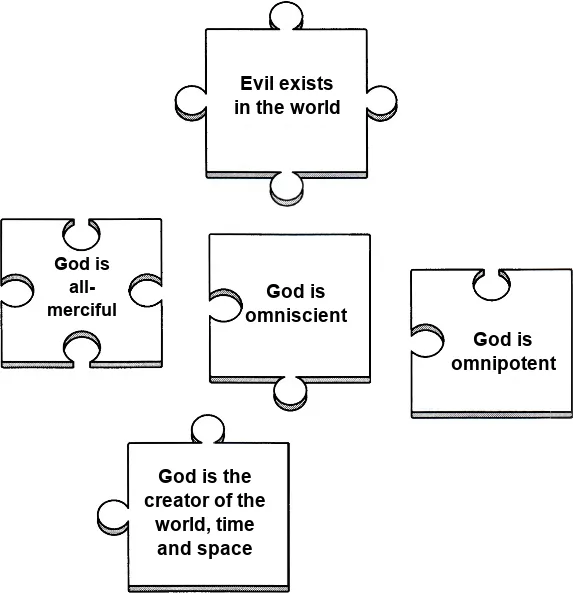
The logical-a priori problem of the existence of evil is formulated in the words of J. L. Mackie as follows:
A- God is omnipotent.
B- God is omniscient.
C- God is benevolent and merciful.
D- A benevolent and merciful being will eliminate evil to the best of their ability and knowledge.
E- There is no limit conceivable to God’s power and knowledge.
F- Evil exists in this world.
Mackie argues that all these propositions cannot be simultaneously true and logically contradict one another. Believers in a creator possessing the aforementioned attributes must abandon at least one of these propositions to accept the rest.
There is no doubt that evil exists in this world; hence, we cannot eliminate proposition (F). Yet abandoning any of the remaining propositions shatters our conceptual picture of an omniscient, omnipotent, and benevolent God, rendering our belief self-contradictory.
The evidential-a posteriori problem of the existence of evil in the words of Darwin:
“To our imperfect minds and limited intellect and knowledge, a God capable of creating the universe must be omnipotent, omniscient, and all-merciful. We cannot conceive of a creator lacking these attributes. On this account, how can one justify the endless suffering and pain of animals in nature over an almost unending period, even prior to the appearance of humanity? The difference between this argument and the former is that its purpose is not to demonstrate a logical contradiction among seemingly true propositions. Rather, Darwin, Hume, and contemporary philosophers like William Rowe, by framing the issue in this manner, intend to prompt believers and confront them with two different logical scenarios, asking: Which scenario is more probable?”
Scenario one: There exists a God of infinite power, knowledge, and mercy who created a world so replete with evil.
Scenario two: No such God exists. Humanity created Him, projected human attributes upon Him, and attempted thereby to answer their questions and make their lives meaningful and purposeful.
William Rowe states that due to the existence of gratuitous evil in this world, one can doubt and deny the existence of the God described by theists. For example, a deer trapped in a forest fire, engulfed by flames, remaining alive for several days with a burned and ruined body, suffering agony until it slowly dies, is in itself evidence of the existence of entirely unnecessary and pointless evil in this world. And no creator endowed with the aforementioned attributes would create such a world. There was no necessity to create a world with so much natural evil, unless we discount and remove the attribute of benevolence (mercy) from His divine attributes.
Of course, this line of reasoning does not lead to the non-existence of God, but it negates the existence of the God of the Abrahamic religions and any other deity endowed with the aforementioned attributes.
Since the initial emergence of the problem of evil and the objections raised by atheists, an unceasing effort has been made by believers to preserve the image of the God of religion while simultaneously explaining the issue of evil and justifying its existence. These justifications can be categorized under four main arguments. In the history of the philosophy of religion, we call these various arguments theodicies. John Hick, the contemporary Christian philosopher, expounds and analyzes two famous theodicies in his renowned book Evil and the God of Love, which will be explained below.
For the sake of simplicity, I classify these theodicies into two groups: strong (those that justify the existence of evil) and weak (those that do not explain the existence of evil, but justify that the existence of evil is not contradictory to the existence of an omnipotent, omniscient, and benevolent God).
The Four Theodicies
The First Theodicy: God exists. The existence of colossal evil in this world is undeniable. But God is neither omnipotent nor omniscient.
In this theodicy, commentators usually adopt an anti-realist stance, regarding God as a creator of limited power who loves His creatures and encourages and prompts them toward goodness, yet lacks the power to destroy wickedness. This view, in a sense, teaches dualism, accepting the existence of God alongside the existence of Satan. A prime example of this position is found in Zoroastrianism and Manichaeism, which regard God as the embodiment of goodness locked in an endless struggle against evil, urging humans in this battle to join the forces of good.
Although such a belief has never been acceptable to the monotheists of Abrahamic religions—who deem it polytheism (shirk)—one must acknowledge that such presuppositions would remove numerous dilemmas from the path of believers, transforming the universe into a far more philosophical, mysterious, acceptable, purposeful, and moral place.
The Second Theodicy: God exists. He is omnipotent, omniscient, and benevolent. The existence of colossal evil in this world is undeniable. But the existence of this evil is justified by the presence of a greater good, which is divine justice.
John Hick explains in this regard that an omnipotent God who is the creator of reason would not permit His creature to exit the stage of existence and be annihilated before yearning toward its ultimate end. In short, Hick’s argument is that God has a plan and purpose for the universe and His creatures, and did not create in vain. Hence, there must exist an afterlife where the justice unfulfilled in this world is realized in the next. He continues that finite and limited suffering and pain in this world, compared to the infinite joy and beatitude of the hereafter, appears as a minuscule speck before a boundless ocean, practically amounting to nothing.
Apart from Hick’s response being somewhat difficult to swallow, it promptly adds an even greater and more intricate dilemma to the previous one: namely, justifying the endless torment, pain, and suffering of Hell in exchange for the limited evil committed in this world!
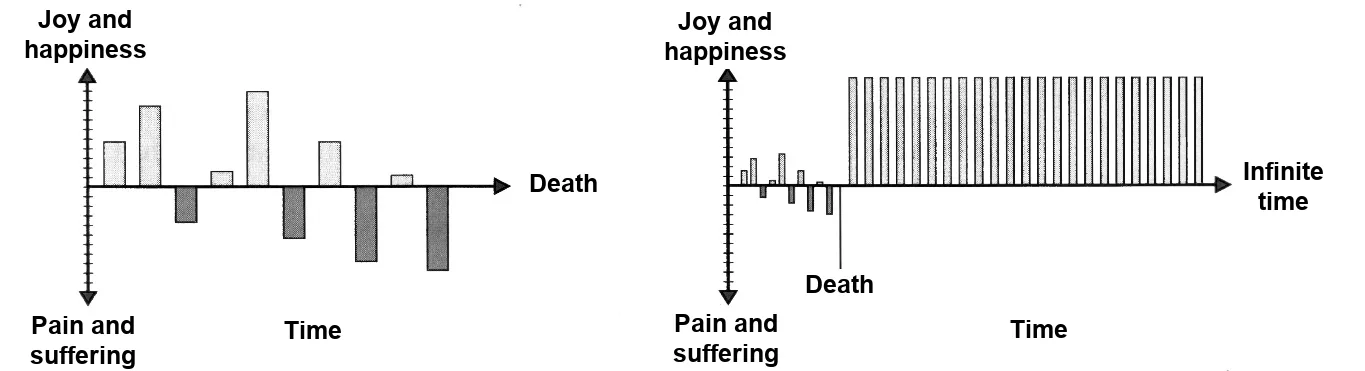
Of course, if we attribute to God the creation of flesh-eating beetles, botflies laying eggs in the eye, the bacteria of cholera, plague, and typhoid…, the rabies virus that kills dogs and humans with agonizing torture, the tetanus virus, COVID-19…, and all these carnivorous beasts that tear apart and consume their prey amidst pain and torture, sparing not even newborn infants, alongside thousands upon thousands of other wicked acts and natural evils in this world, then accepting that such a creator would also fashion a place like Hell—with that bizarre and monstrous machinery of torture and torment unimaginable to any twisted mind, torturing humans therein for all eternity—does not seem so far-fetched.
The Third Theodicy: God exists. He is omnipotent, omniscient, and benevolent. The existence of colossal evil in this world is undeniable. But the existence of this evil is justified by the presence of a greater good, which is human free will.
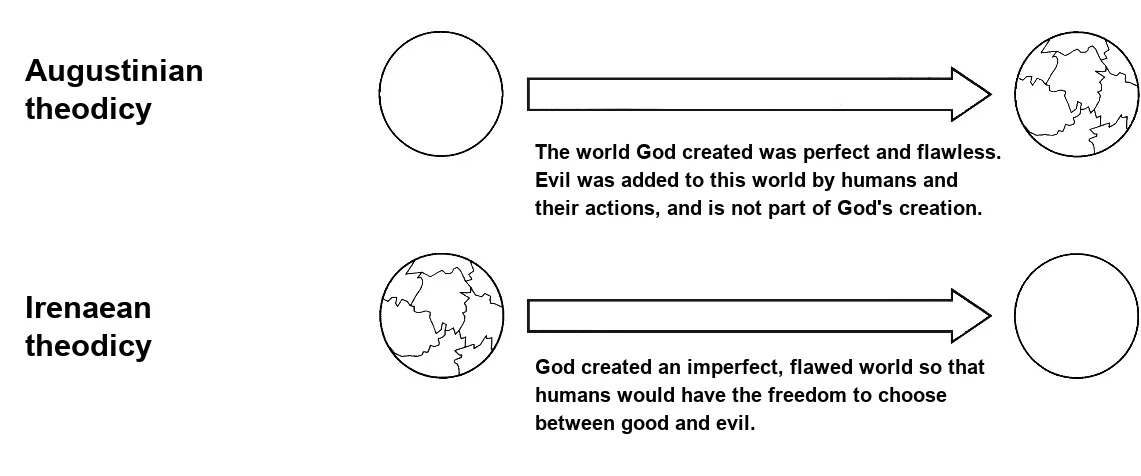
Saint Augustine considered humans and angels to be endowed with free will, attributing the existence of evil to the temptation and deception of Satan, who led Adam astray from the path of goodness and initiated wickedness. He regards natural and moral evil as the product of the conscious, free choices of God’s creatures, not of God Himself. He even regards a creature possessing free will, such as a living horse that may prove unruly and throw its rider to the ground, as having greater value than a creature lacking free will, such as a stone horse.
Alvin Plantinga, the contemporary Christian philosopher, expounds Augustine’s statement as follows: A world containing free creatures who, like a living horse, are sometimes obedient and sometimes rebellious, is better and more acceptable than a world filled with stone horses or robots devoid of free will. Choosing between good and evil is the choice that makes this world worth living in. Plantinga’s obvious fallacy in this argument is comparing a living organism with an inanimate object. Even a living horse may lack free will yet exhibit the illusion of volition, and we might remain entirely ignorant of the underlying reality. Yet there is no ontological difference between a living horse lacking free will and a stone horse. Brief mention can be made of the Turing test: in this test, a human interrogator engages in a verbal exchange with an artificial intelligence; if, at the conclusion of the dialogue, the interrogator cannot determine whether they were interacting with an artificial intelligence (an entity lacking free will) or a human possessing volition, the tested AI passes the exam. Thus, it is possible to create entirely deterministic beings that convey the illusion of free will in their interactions with humans. In that case, there is no difference between a living horse, a stone horse, an artificial intelligence, or a robot.
We spoke briefly about free will and determinism. But it is worth raising the point that believing in free will for a creature that is finite and imperfect—and who, at their finest and most complete state, can only be a happy, moral, confident, kind individual, in short, what the contemporary psychologist Maslow defines as a self-actualized human, and nothing more—is contradictory and anti-rational.
Viewing the matter from a causal perspective as well, for our will to be freely exercised, we would have to isolate it from the influence of neurochemical reactions in the brain, the effects of electromagnetic waves on atoms and electron excitations in brain neurons, memories and emotions, learned behaviors and environmental stimuli, hormonal imbalances, psychological trauma, psychiatric disorders, and so forth. Yet we know that all the aforementioned factors influence our choices, and we chose virtually none of them. In that case, if we wish to regard human voluntary choices as completely independent of these factors, we must posit them as uncaused. By doing so, we violate causality; and even if we accept that our will is not governed by causality and operates purely randomly, we have still conceded that our will is not within our control, being uncaused and random. In that scenario, how can we expect reward or punishment? In general, belief in completely free will in the modern world, after the consolidation of modern science, biology, and psychology, is a contradictory proposition.
And even if, despite all the aforementioned problems, we accept the believers’ claim regarding divine will and justice, the above theodicy still fails to account for natural evil. Through this argument, we might be able to lay the blame for all historical moral evil upon humans and human choice, but this vast suffering and torment in the animal kingdom, from the dawn of life to an indefinite future, remains unexplained by this theodicy.
Perhaps the following verse from Saadi captures this well:
“What grief does the angel appointed over the storehouses of the wind feel,
Should the lamp of a poor widow be extinguished?”
In this couplet, the creator’s non-intervention in details is depicted well, alluding to the idea that God does not intervene in micro-matters. This in itself signifies that God either lacks the power to eliminate evil, or lacks the will to eliminate evil, or both.
Another point: Was God Himself the creator of the COVID-19 virus, or did this virus emerge spontaneously, outside God’s will, as a result of evolution? (Of course, the answer of scientifically minded atheists to the above question is evolution and natural selection.) But if we consider the emergence of this virus, and likely many other vicious species of life, to be the product of evolution, we have implicitly admitted that even if God created this world in the beginning, during the evolutionary process this world turned into a place full of evil; and if we do not subsume this under God’s will, viewing evolution as possessing an independent drive based on micro-changes in each generation driven by mutation and the result of natural selection, this indicates the non-creation of this world by an omniscient, purposeful, and omnipotent creator. If, however, we regard this virus and the rest of living organisms as part of God’s creation, one must ask: Did God create an organism with the potential capacity to generate evil out of benevolence? Is such a thing possible? Does not this virus, by killing humans, convert its potential capacity to cause evil—which is the product of divine mercy toward it (toward the COVID-19 virus)—into an actualized capacity? What can be said about cancer and genetic disorders? Even if, as Mr. Mirdamadi suggests in his interview, this virus was the result of the greed and indulgence of certain people in China who consumed pangolin meat, should the retribution for the greed and consumerism of one or a few individuals in China engulf children, the elderly, mothers, and fathers across the globe? Was God aware of this latent evil when He created COVID-19, or do we still wish to cling to the refuted argument of open theism? Even if God provides great rewards in the hereafter for the faithful (though not for unbelievers), this does not mean the eradication of this evil or other evils. It does not diminish God’s responsibility in creating the primordial evil—an evil that, in the words of Mr. Parsa (responding to Mr. Mirdamadi), might not have existed. And is it not the right of disabled and tortured children to demand justice regarding God rather than receiving a reward, placing God in a painful condition similar to their own? Mr. Mirdamadi answers the above question again by appealing to the argument of human volition and free will, claiming that God is like a physician who inflicts pain to heal, yet this pain is necessary.
Whereas for an omnipotent being, inflicting any pain is not necessary, since in the presence of infinite power, necessity is meaningless. However, the following point is noteworthy:
Human beings were created with very limited faculties. For instance, humans do not have the ability to fly, do not have the choice to read or not read others’ minds, do not have the choice to turn invisible or not, do not have the choice to live underwater or above water (they are forced to live above water), do not have the choice to cast a Crucio curse from afar like sorcerers to inflict pain and torment upon others, and so on… In short, there are infinite varieties of choices between good and evil in this world that an omnipotent being could exercise, but they are not defined for humans and their limited capabilities, falling outside human free agency and free choice. From a religious perspective, has this diminished human free will? Does all this vast array of choices from which we are excluded due to our bodily and mental limitations—choices we do not even contemplate—violate our free will in the eyes of believers? It seems that the response of Mr. Mirdamadi and other believers who defend free will would be no. Now, following this very reasoning, could not humans have been created without the ability to lie, with falsehood entirely undefined in language? Or without the ability to kill another? If the inability to choose between lying and truth-telling were added to the list of infinite other choices from which humans are barred, would human free will be undermined? The likely answer is that God could certainly have created things this way. Now, given the earlier examples, would this have violated human free will? Would humans not still have remained free to decide regarding an infinity of other matters?
A clearer illustration of this contradiction is Paradise itself.
Question: Does evil exist in Paradise? Believers’ answer: No!
Question: Is the transcendent human who has attained God in Paradise like a pleasure-seeking robot? Or do they possess free will? Believers’ answer: Yes, they certainly possess free will.
Conclusion: Free will is possible in a world without evil, and evil is by no means a necessary condition for free will.
In my view, an honest answer from believers to the above question could serve as the key to resolving this historical fallacy regarding the problem of evil and free will.
The Fourth Theodicy: God exists. He is omnipotent, omniscient, and benevolent. The existence of colossal evil in this world is undeniable. But the existence of this evil is justified by the presence of a greater good, which is the fulfillment and actualization of human capabilities and potential faculties.
“Wayfarers of the path tread the road of affliction, my friend;
What fear has Love of ups and downs?” (Hafez)
John Hick, in his book Evil and the God of Love, offers a different explanation for the existence of evil. One of his claims is that the presence of evil in this world enables human beings to grow, mature, and bear fruit. The existence of evil provides conditions in which the human soul can be polished, hardened, and tempered. John Hick adopts this argument from Saint Irenaeus, who believed that God could have created humanity perfect from the beginning, but humanity, traversing its infancy, was not prepared to receive such a volume of grace and had to traverse this path on its own, step by step and gradually.
Perhaps regarding these last two theodicies, it must be said that both consider the existence of evil necessary for the realization of a greater good. At the same time, they introduce exceptions to God’s omnipotence, such as asserting that God cannot create a free being while simultaneously fashioning them so that they do not incline toward evil. Mr. Mirdamadi provided the example that God cannot create a square circle.
The difference between the Augustinian theodicy, based on free will, and the Irenaean theodicy, based on human soul-making and spiritual progression, may perhaps be illustrated by the following diagram:
Mr. Mirdamadi touches upon this theodicy in another part of his remarks, saying: “A world in which God constantly intervenes to rectify human wrongdoing would leave no room for humans to learn lessons and be tested. The valuable experiences acquired by the human race over centuries are the fruit of grappling with hardships; as attributed to Khayyam, ‘Through enduring suffering does man become noble [hurr].’ If hardships were perpetually removed from man’s path by divine intervention, learning from experience would not occur, and humanity would neither attain maturity nor become responsible.”
If we extend this argument, we reach the following logical conclusion:
God created a world where evil was woven into its essence from the very beginning. Whether God had an alternative or not makes no difference to the fact that evil was intended to exist in the world from the outset so that humanity, in Mr. Mirdamadi’s words, might become noble through suffering. Thus, Satan not only did not disobey, but indirectly fulfilled God’s purpose entirely. Hence, Satan must be regarded as an undercover agent of the celestial machinery who, by feigning enmity with God and deceiving humanity, was in fact commissioned to generate evil, which formed an integral part of God’s plan for creation. Whether Satan initiated evil out of determinism or free will makes no difference to God’s overall plan. Even if we do not consider evil in this world as part of God’s design and deem it forced upon God, there is still no doubt that God made the decision to create this world and Satan. And innocent, naive humanity was toyed with like a helpless puppet, participating in God’s plan without being aware of the whole scheme, while billions of humans fell victim to this design and will burn in the fires of Hell forever! Once again, it must be stated that these contradictions arise solely from accepting the creation narrative of the Abrahamic religions and the portrait they offer of a perfect and all-benevolent creator. If we alter the foundational premises and distance ourselves from the image presented by these religions—which is nothing other than the ancient myths of the Jewish people—we can offer a far more rational, justifiable, moral, and scientific account of creation and existence.
Furthermore, the claim that evil exists in the world because God placed it there for a greater good—so that humanity, in Mr. Mirdamadi’s phrase, might attain maturity and responsibility—unfortunately resembles a grim joke. By John Hick’s own admission, the distribution of misery and suffering in the world is entirely random and haphazard, and it is entirely plausible that these tribulations fall upon those least deserving of such misfortune. In such a world, it is extraordinarily difficult to accept that an ultimate good lies behind this futile evil, justifying billions of years of evil (merely on planet Earth, not even in the rest of this vast cosmos) for humans, animals, and similarly for sinners who, in an even more dreadful manner, fall victim to this gratuitous evil, their souls suffering torment in Hell for all eternity. In truth, sinners are the most oppressed victims of this injustice; for they will endure the worst tortures—inconceivable to our minds in this world—not merely during a human lifespan of less than a century, but for eternity.
Mr. Mirdamadi remarks in this regard: “Tawhid imposes an intrinsic limitation upon God, yet this limitation is not a defect in God, but His perfection—like a mathematical genius who cannot fail to solve a complex mathematical equation swiftly. This inability is not his flaw, but his perfection. Thus, regarding God as well, one can say that whatever God creates is imperfect; for creation, though ‘from’ God—and to the extent that it is ‘from’ God, it is good—is not identical with God, and therefore possesses an inherent defect. And the inherent defect of the material world brings in its wake natural evils such as floods, earthquakes, and infectious diseases.”
If we accept the above argument (which, of course, is steeped in the fallacy of false analogy), God knows that He Himself is a simple, complete, and necessary existence. He is therefore aware that whatever He creates other than Himself will be imperfect and defective (compared to His own perfection). Knowing such consequences, why does He create? And then, on account of the very defects evident from the outset, He sits in judgment and decrees terrifying punishments (eternal painful torment)? Is this action morally justifiable?
In the novel The Brothers Karamazov, Dostoevsky depicts painful and heartbreaking examples of this gratuitous evil. In a section of the book, Ivan Karamazov points to three horrifying and bitter cases of assault and pointless torment inflicted upon children, declaring that these alone are sufficient reasons not to believe in God’s benevolence. He does not deny God’s existence, but feels a sickening revulsion toward this world God has created. He does not consider God a being worthy of bowing down to.
A Note on Possible Worlds
Now let us view the issue in this manner: Could God have created a world identical to ours in every respect, except that in this world, the coronavirus protein was engineered in such a way that it could not be transmitted to humans? If the answer is no, this conflicts with God’s omnipotence. And if the answer is yes, would not creating such a world have been slightly better or slightly more moral than creating this world? Why, then, did God forgo creating this hypothetical world and other possible worlds in which the amount of evil is far less than in the present world?
Leibniz, the German philosopher and polymath, frames the matter as follows in his important treatise (The Monadology):
1- God possesses an idea of infinitely many possible worlds.
2- Only one of these worlds can exist outside God’s mind in reality.
3- God, through His divine wisdom, determines which one to choose.
4- God is good.
5- Therefore, the world God created is the best of all possible worlds.
First, either this system denies the theory of parallel universes in modern physics (which is an unscientific and anti-rational stance), or we must take all possible parallel universes together and call the totality of all these universes the world created by God. That is, we consider our four-dimensional universe (three spatial dimensions and one temporal dimension) as one of the infinite universes (with higher or lower dimensions than ours) that God (a being in an eleven-dimensional space) created simultaneously and in a single instant; in which case the world must be taken as the sum of all infinite possible worlds, our universe (the entire cosmos we know, roughly fourteen billion light-years in extent and composed of over one hundred billion galaxies, our galaxy being just one of them) being merely one of these infinite worlds. Yet even in that case, numerous contradictions arise.
For example, among these infinite worlds, there must logically be a world in which less evil exists than in our world. That is, when God contemplates these infinite worlds, He must automatically know that a world in which Tamerlane killed one fewer person than in our world, or a world in which the plague caused fewer casualties, is possible. Or even a world in which Satan did not embark upon the path of hypocrisy and evil is possible. Yet God resolved to create all these worlds, in a great many of which immense evil exists. That is, He accepted from the outset to create a world with the specifications of our world (with a specific amount of pain and suffering, a specific degree of free will, a specific measure of determinism, a specific degree of order and disorder, and a specific balance between ugliness and beauty…). Could He have chosen these parameters differently from the start? If He could and chose not to, then it must be said that all humans and animals that have fallen or will fall victim to evil were condemned from the beginning by God’s choice. And if He could not, one must ask: How is His omnipotence justified? Furthermore, knowing that He lacked the power to create a better world, why did He consent to create a world knowing that billions upon billions of His creatures would endure agony, pain, and suffering, and billions upon billions of the wretched souls of His creatures would face Hell and eternal painful torment due to the very characteristics of this world where humanity is imperfect and evil exists?
Voltaire, in his famous novel Candide, sharply criticized Leibniz and rejected his possible worlds argument. In a scene from the novel, where Doctor Pangloss is hanged and his pupil is dying under the brutal torture of religious fanatics, Candide wonders that if this world is, as Pangloss asserts, the best of all possible worlds, what must the other worlds be like?
Many philosophers, including Bertrand Russell and Antony Flew, raised serious objections against the Leibnizian model, regarding it as rationally untenable. Below, however, I will turn to Mr. Mirdamadi’s reference to the aforementioned argument.
Yasser Mirdamadi: “Is a ‘perfect world’—in the sense of a world in which no flaw enters and it is impossible to conceive of a more perfect world in all aspects—possible at all? In other words, is the ‘best of all possible worlds’ possible? If such a world is not possible, then God cannot create it either, because God’s power pertains only to possibilities… Continued: Now, a similar argument can be conceived regarding the ‘best of all possible worlds.’ Suppose that L is the best possible world, yet one can still conceive of a better world. Suppose that one of the virtues of the ‘best of all possible worlds’ is that it contains many or infinitely many stars; yet one can always conceive of a better world containing even more stars. Thus we will have L+1, but this too is not the ‘best of all possible worlds,’ because a better world can still be conceived, and this can continue ad infinitum without ever reaching the ‘best of all possible worlds.’ On this basis, the ‘best of all possible worlds’ is a contradiction in terms, and the existence of such a world is impossible. And if the ‘best of all possible worlds’ is not possible, God is under no obligation to create it, because even God cannot create that which is impossible, and no one, not even God, is obligated to do the impossible.”
In his argument, Mr. Mirdamadi implicitly refers to the phenomenon of infinity in mathematics. To clarify the matter, the following explanation is useful: In mathematics, the concept of infinity is an exceedingly complex and mysterious concept. The smallest infinity, typically represented by the set of natural numbers (the set of integers and the set of rational numbers are also equal to this same infinity), is known as aleph-naught or ℵ₀.
Yet we know that the power set of ℵ₀ (2^ℵ₀), which is an infinity greater than ℵ₀, is an uncountable infinity larger than ℵ₀. Georg Cantor, the German mathematician, demonstrated in a treatise that the set of real numbers between 0 and 1 is itself an infinity far greater than ℵ₀, which he designated as ℵ₁. And similarly, larger infinities up to ℵ_ℵ₀ can be defined. If we designate God as an infinity greater than ℵ_ℵ₀, say θ, it can be readily argued that for God, accessing His own length and breadth and communicating with His own boundaries is mathematically impossible. For by definition, the power set of the infinite ℵ_ℵ₀, which is smaller than θ, consists of infinitely many infinite sets, and using set theory it can be shown that θ is an infinity even greater than ℵ_ℵ₀, which is not only uncountable but cannot even be approached (converged to) from below. Thus, such an entity that is θ (God cannot be less than θ, for in that case an infinity greater than Him could be defined) certainly lacks the capacity to access and exercise control over all of Himself. And this contradicts God’s simplicity (divine simplicity), because we would have to define God as an infinity of smaller sets that possess internal coherence and solidity. In such a scenario, one can understand that although a number close to ℵ₀ could be assigned to all possible worlds, the number of possible worlds is still less than this smallest infinity. Because in any possible world, the amount of matter, fundamental particles, and space is finite. And this means that in any hypothetical world, there exists a countable number of different configurations of these particles in space and time. Thus, that part of God which created our world (according to the previous argument, not all parts of God are capable of communicating with each other) must have chosen one from among a finite number of possible worlds. Now, if we consider the world containing the greatest evil and the least good as the worst possible world, and the world containing the greatest good and the least evil as the best possible world, our world lies somewhere in the middle of this spectrum of good and evil. Therefore, if we move along the spectrum toward goodness, there is certainly another world on this spectrum after ours in which evil is one degree less. But if we say that this world with less evil was not an available choice for God, we are automatically pointing to God’s limitation, not to a limitation of logical possibility. In the theory of infinity, it can be shown that for an infinity like θ, counting ℵ₀ is possible, and it can readily be accommodated within θ. Thus, for God, choosing a world even from among infinitely many (ℵ₀) possible worlds is feasible. Although for common sense this argument is somewhat difficult to digest, in mathematics it can be demonstrated and examined. Yet God created a world with all this evil and wickedness. If we wish to define a God for this world, shouldn’t we doubt His benevolence or His omnipotence, and review our foundational premises anew?
Secondly, if we consider God, as Mr. Mirdamadi asserted, incapable of creating the best of all possible worlds, we must still ask: if creating a better world than ours was possible for God, would He have created it or not? The answer presumably should be yes, certainly, because God is benevolent. Yet apparently, this world is the best world whose creation was possible for God. In that case, should we not consider God constrained by determinism and held captive by evil? For if God is benevolent, creating a world in which evil exists must have occurred for Him out of some form of compulsion. Because owing to His benevolence, God certainly desired to create a world without evil, but due to the limitation of resources/possibilities, He created the best world He could. Thus, one must say that God out of compulsion (for example, the compulsion that God could not create a creature capable of thriving, maturing, and becoming noble without the need for evil) created a world containing evil, and this automatically negates His absolute free will. And we must regard Him as compelled to endure evil and accept evil as part of the world He created. According to Mr. Mirdamadi, there exist ℵ₀ possible worlds that God cannot create, because creating any one of them would raise the doubt: Why didn’t You create the next world, which was better? I tried to explain that the number of possible worlds is actually not infinite, but finite. However, because God lacks access to the entirety of His own being, He lacked the capacity to create a better world; thus we must consider God trapped in a deterministic choice, because God was unable to create the best possible world. Of course, in this argument, the assumption that a world better than ours is conceivable is taken as axiomatic.
In conclusion, it must be said that the dilemma Dostoevsky points to raises this crucial question: Does the end justify the means? Any theodicy that considers the creation of evil and wickedness as a means to achieve the ultimate goal of creation will encounter this fundamental problem: Was achieving that goal worth all this wickedness, suffering, pain, and torment? That too for a creator who, by definition, was and is completely perfect and self-sufficient? Are not all these humans who, throughout history, were born during an era when humanity was traversing its civil, intellectual, social, scientific, cultural, and economic infancy, and consequently fell into the path of evil, turning this world into a place of suffering and torment for themselves and others, and according to religious believers were also subjected in the hereafter to the creator’s eternal punishment—are they not the helpless and defenseless victims of this immoral plan of the God of these religions? In other words, was God’s act in creating a world with so much gratuitous evil aimed at achieving a prospective purpose He had for creation, which is still not fully revealed to anyone? If so, was this act morally justifiable? For Ivan Karamazov, the answer is an emphatic no. No end justifies sanctioning the unceasing torture of innocent children over thousands of years on the part of a creator endowed with total power, total knowledge, and total mercy.
It must be acknowledged that the answers provided by these four theodicies regarding the problem of evil offer no robust and rational justification for the actions of the God defined in the Abrahamic religions. And they likely demand heavy costs from believers and a fundamental alteration in their core beliefs about God.
Let us also add that one can readily argue that an evil and evil-loving God created this world, and one can utilize all the preceding theodicies to advance evidence for God’s malevolence rather than His benevolence. At the same time, the evidence and indications for God being evil-loving or malevolent are abundant. Just as the creator or designer of this world could be benevolent, it is entirely logical to assume that this creator could be malevolent—just as a person who breeds a specific species of animal may be cruel toward them, abusing and torturing them for pleasure, experimentation, entertainment, curiosity, or a personality disorder; or creating conditions where they fight, kill, or maim one another. If we were to believe in a malevolent God, just as easily as a Christian or Muslim defends God’s benevolence and offers arguments for it, we too could defend and argue for the creator’s malevolence. For example, in such a system, a critic could frame the dilemma under the title “the problem of good,” presenting ample arguments and evidence for the existence of goodness, beauty, joy, innocence, and so forth in this world to prove that God cannot be purely malevolent. And of course, in response to them, one could argue that all the beauties of this world were created precisely to perish, or over the course of history and in confrontation with evil to become flawed, ugly, aged, and deficient, generating pain and suffering in humans. For in a world filled with evil and devoid of good, pain and suffering are not felt as acutely as in a world where good, beauty, and joy are turned by evil into badness, ugliness, and pain. Another example: Why did God create the beauty of the sunrise? So that we might better feel daily, routine pain and suffering and our impending march toward death and nonexistence. Why did He give us a healthy body? Because after a short time, this body becomes worn, ugly, and aged, leading us toward death with perpetual pain that worsens every day. It is logical to say that to maximize pain, one must first bestow upon humans something good yet fleeting and brief, and shortly thereafter snatch it away, replacing it with pain and suffering. If we say a benevolent God exists, we must explain the existence of evil; and if conversely we claim that God is malevolent, in that case we must explain the existence of goodness, virtue, and beauty.
God is aware that if He looks into the future, He will know who is destined for Hell and who for Paradise, yet He does not look. God could have known by looking into the future that if He created Satan, he would cause evil and lead humanity astray, and the innocent lives and souls of billions of humans would be cast into Hell. But He chose not to know (the open theism argument) yet created anyway—why? Or He knew and created anyway—why? Given that this world is not the best conceivable possible world, and many better worlds can be imagined, must we accept that in terms of logical possibilities, this was the best possible world to create? If so, and if we accept that God was aware His hands were tied in creating a world without evil, why did He create at all, subjecting human lives to the pleasure, adventure, or thrill of creating this world filled with evil? Or if we think He did not look into the future, why? Whereas looking into the future would have prevented God from creating beings who would generate evil and merit the infinite wrath and torment of the creator. Why, by not looking into the future, does He create those in whose hearts is a sickness such that they do not see the truth and ultimately become victims of God’s eternal torture chamber (Hell)? Why does He wish to create those whom God Himself, prior to their creation, could know are weak, diseased, sinful, and producers of evil? Does this action of God have moral justification? Why are beings whose failure is certain prior to their existence created by an omnipotent, omniscient, and benevolent creator to generate evil and then suffer eternal painful torment? Does creating a being with disease and defects and then subjecting them to infinite reward or punishment have rational and moral justification? No creature consciously and in a sound mental state has ever chosen or will choose torment; yet in the theory of Abrahamic religions, the outcome of certain acts—all occurring within the divine examination system—is eternal painful torment for the creature. Now, if some individuals have a disease in their hearts and a veil over their hearts, eyes, and ears such that they are deaf and dumb, and their failure in this examination is predetermined, should they be permitted to participate in the examination (life in this world) and then receive a horrifying punishment (eternal painful torment)? Is it not the case that the depiction of such a creator with such attributes is a contradictory and anti-rational image?
Has the time not arrived either to accept science and scientific answers, distance ourselves from unfalsifiable and unjustifiable beliefs that render our world full of contradictions and flaws, and seek the meaning of life in poetry, music, art, love, wholesome human relationships, and the like; or at least to alter our image of this God fashioned by the mythology of the Jewish people and pre-modern worldview, science, and morality, and create a God in harmony and compatibility with modern rationality?
I was no
pitiable, compliant slave,
and my path to the heavenly paradise
was not the goat-track
of obedience and humility.
I needed a different kind of God,
worthy of a creation
that does not bend its neck
for its inevitable crust of bread.
And a God
of a different kind
I created…
(From the poem “Abraham in the Fire,” by Ahmad Shamlou)
References
1 – Mirdamadi, Yasser. (1399 SH), The Absence of “God,” the Corona Pandemic, and the Framing of the “Problem of Evil” in Conversation with Yasser Mirdamadi.
https://www.zeitoons.com/75479
2 – Kadivar, Mohsen. (1399 SH), “God” Is a Law-Governed Being: The Corona Pandemic and the Framing of the “Problem of Evil” in Conversation with Mohsen Kadivar.
https://www.zeitoons.com/74709
3 – The Holy Bible, Old Testament, Isaiah, Chapter 45, Verse 7
4 – Quran, Surah Al-Kahf, Verse 57 (Saheeh International translation)
5 – Hume, Dialogues Concerning Natural Religion, p. 91-92, 105
6 – Russell and Copleston, ‘The Existence of God – A Debate’, p. 136
7 – Aquinas, Summa Theologica, 1:2:1
8 – Capote, T., 2000, In Cold Blood, Penguin, p. 84, 237
9 – St. Augustine, Confessions, Book 7, Chapter 5.
10 – Hick, John. Evil and the God of Love, p. 3, 18, 292-293, 374.
11 – Mackie, J. L., ‘Evil and Omnipotence’ in 1971, The Philosophy of Religion, B. Mitchell (ed.), Oxford University Press, pp. 92-101
12 – Dostoevsky, F., 1970, The Brothers Karamazov, Bantam, pp. 295-296
13 – St. Augustine, The Nature of the Good, 4
14 – Spinoza, Baruch. Ethics, 1991, Hackett, pp. 38-40
15 – Plantinga, A., 1975, God, Freedom, and Evil, Harper & Row, p. 20
16 – Choquet-Bruhat, Yvonne. General Relativity and the Einstein Equations, 2008, Oxford University Press, pp. 55-56
17 – Faticoni, Theodore G., The Mathematics of Infinity: A Guide to Great Ideas (Pure and Applied Mathematics), 2012, Wiley-Blackwell.
18 – Swinburne, Richard, 2010, Is There a God?, Oxford University Press, pp. 88-99
19 – Nagel, Thomas, Mind and Cosmos, 2012, Oxford University Press
https://www.zeitoons.com/76909
Source: This article was first published on the Zeitoon website. Republication is permitted with credit to the source, according to Zeitoon’s own announcement.